The Architecture of Trust: How Intimacy Coordinators Are Transforming the American Stage

For much of theater's long history, the staging of intimate or physically vulnerable scenes operated largely on instinct, goodwill, and the unspoken hope that everyone in the rehearsal room shared the same understanding of appropriate boundaries. Directors issued guidance, performers improvised solutions, and the results ranged from genuinely moving to quietly damaging. The absence of a formal framework was rarely discussed openly — it was simply the way things were done.
That framework now exists. And across American theater, from regional houses in the Midwest to off-Broadway stages in New York City, it is changing the nature of rehearsal itself.
From Film Sets to Stage Floors
The role of the intimacy coordinator first gained widespread visibility in film and television, particularly in the years following the cultural reckoning of the late 2010s. Organizations such as Intimacy Directors International and Intimacy Professionals Association began formalizing training programs, establishing ethical standards, and placing coordinators on sets where physical vulnerability was part of the work. Theater, which had always prided itself on its collaborative ethos, took notice — and began asking whether its own rehearsal culture was as safe as it believed.
The answer, many practitioners found, was complicated. Stage productions often involve weeks of repeated rehearsal of the same physical moments, a cumulative intimacy that differs substantially from a single camera take. Performers are asked to return, night after night, to scenes requiring emotional exposure, physical contact, or simulated violence. Without a trained intermediary, the responsibility for managing that exposure had historically fallen on the performers themselves — or, more troublingly, on no one in particular.
"What we offer is not supervision in a punitive sense," explains one working intimacy coordinator who has collaborated with several regional theater companies over the past four years. "It is a structured conversation about consent, about what each performer is genuinely comfortable with, and about how to achieve the artistic intention of a scene without requiring anyone to sacrifice their psychological safety to get there."
The Choreography of Vulnerability
In practice, the work of an intimacy coordinator resembles, in certain respects, the work of a fight choreographer — a role theater has long embraced without controversy. Stage combat requires specialized training, clear notation, and repeated precise execution to ensure no performer is harmed. Intimacy coordination applies the same disciplined thinking to scenes involving romantic contact, nudity, or emotional rawness.
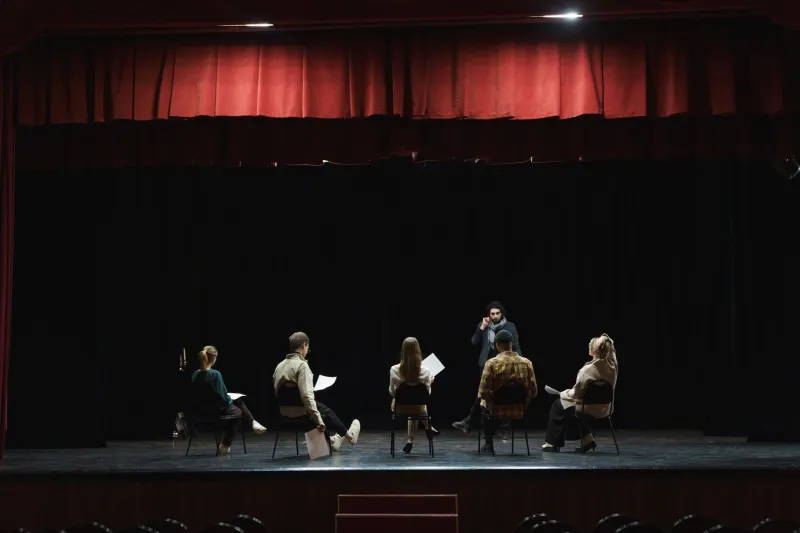
Coordinators typically enter the rehearsal process during pre-production, meeting individually with cast members before any staging begins. These conversations establish what is sometimes called a "yes/no/maybe" framework — a clear articulation of what each performer will and will not engage with, and what might be negotiable given the right conditions. The coordinator then works alongside the director to design staging that honors both the artistic vision and the expressed boundaries of the performers.
This process, many directors report, does not constrain creativity. It often expands it. When performers trust that their limits will be respected, they frequently access deeper levels of vulnerability than they would otherwise permit themselves. The paradox of intimacy coordination is that its primary function — the establishment of boundaries — tends to produce freer, more authentic performances.
"There is something that happens in a performer when they know the room is genuinely safe," says a director who recently staged a production of a contemporary American play involving several scenes of sustained physical intimacy. "They stop managing their own protection and start doing the actual work. That shift is visible. The audience feels it, even if they do not know why."
Resistance, Reassessment, and Acceptance
The integration of intimacy coordinators into American theater has not been without friction. Some veteran directors and performers initially questioned the necessity of the role, expressing concern that the formalization of consent could introduce a clinical quality into moments that depend on spontaneity and emotional risk. Others worried that the presence of a coordinator might signal institutional distrust of the creative community's ability to govern itself.
Those reservations have largely softened as the profession has matured and its methods have been refined through practical application. Many of the most experienced theater artists who were initially skeptical have become advocates, having witnessed firsthand the difference a skilled coordinator makes — not only in the rehearsal room but in the long-term well-being of the performers involved.
The Actors' Equity Association, which represents American stage actors and stage managers, has been developing guidance around intimacy coordination in recent years, a development that signals the profession's growing institutional legitimacy. Several major regional theater companies have begun including intimacy coordination as a standard line item in their production budgets, rather than treating it as an optional expense.
The Psychological Dimension
Beyond the immediate practicalities of staging, intimacy coordinators are increasingly recognized for the psychological function they serve within a company. Theater productions are, by nature, emotionally intense environments. Performers invest deeply, rehearsal periods can extend over many weeks, and the pressures of opening night create a compressed, high-stakes atmosphere that can complicate interpersonal dynamics.
In this context, the coordinator serves as a consistent, neutral presence — someone whose sole professional commitment is to the well-being of the performers in physically vulnerable situations. That neutrality matters. It provides a resource that exists outside the usual hierarchies of a production, where a performer might hesitate to raise a concern with a director or a stage manager for fear of appearing difficult.
"People sometimes come to me with things that are not strictly within my formal scope," one coordinator acknowledges. "A feeling of discomfort that they cannot quite articulate. A sense that something in rehearsal has been moving in a direction that troubles them. Part of what I do is help people find language for what they are experiencing, and then help them figure out whether and how to address it."
A Profession Still Finding Its Footing
For all the progress of recent years, intimacy coordination in American theater remains a young discipline. Training programs vary in rigor and approach. Standards for what qualifies a practitioner have not been fully unified across the industry. The cost of hiring a coordinator can be prohibitive for smaller companies operating on limited budgets, raising questions about equitable access to this form of professional support.
Those working within the field are aware of these limitations and are actively engaged in addressing them. Conversations about sliding-scale fee structures, pro bono work with emerging companies, and the development of accessible training resources are ongoing within the professional community.
What is not in question is the direction of travel. American theater, like every performing art, is a living institution — one that adapts to the evolving understanding of its practitioners, its audiences, and its cultural moment. The intimacy coordinator represents one of the more significant adaptations of recent decades: a formal acknowledgment that the stories told on stage, and the people who tell them, deserve the same care and precision that theater has always brought to its lighting, its scenery, and its sound.
The stage, as this publication has long believed, is where life comes to life. It follows that the people who inhabit it deserve nothing less than the full architecture of trust.