Curtain Raisers: The School Stages That Launched Extraordinary Theatrical Careers
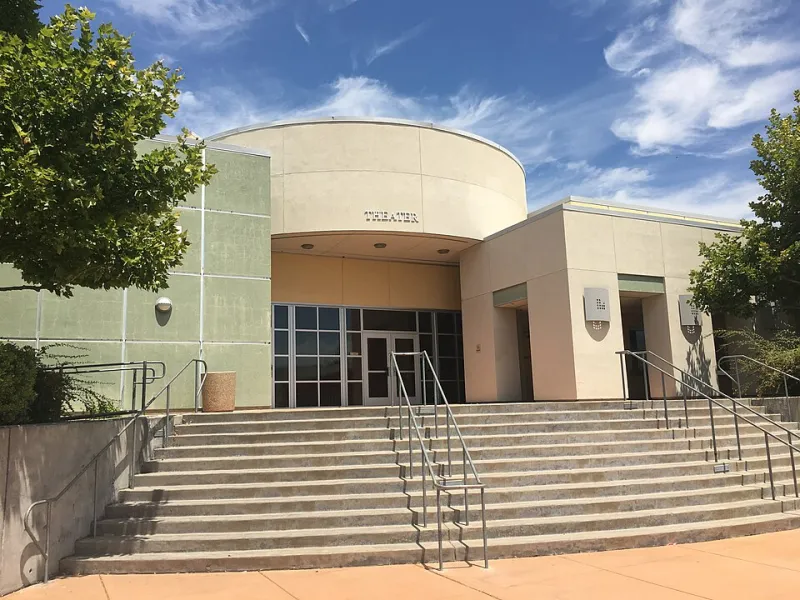
Photo: Vibrioidxire, CC BY-SA 4.0, via Wikimedia Commons
There is a particular kind of magic that lives in a high school auditorium on opening night. The costumes are not quite right, the lighting board is operated by a junior who learned the software three weeks ago, and the lead has been fighting a cold since Tuesday. And yet — something real and electric happens when the curtain rises. For a remarkable number of the artists who would go on to define American theatrical and popular culture, that unglamorous, imperfect, irreplaceable experience was the beginning of everything.
At EA Theatre, we believe that the story of professional theater cannot be honestly told without honoring its origins in school gymnasiums, community centers, and modest campus black box spaces across the country. What follows is a celebration of that lineage — and a practical guide for the young performers who are, right now, writing the next chapter of it.
Viola Davis: Finding Her Voice in Providence
Before Viola Davis became the first Black woman to achieve the Triple Crown of Acting — an Oscar, an Emmy, and a Tony Award — she was a student at Rhode Island College discovering the transformative power of performance. Davis has spoken extensively about the role that academic theater played not merely in developing her technical skills, but in giving her permission to occupy space and command attention in a world that offered her few such invitations.
What made her educational theater experience singular was not the prestige of the productions but the depth of the commitment her instructors demanded. Davis has credited her college training with teaching her to approach every role — regardless of scale — as worthy of full emotional investment. That discipline, forged on modest institutional stages, became the bedrock of a professional practice that would eventually captivate Broadway audiences and global film viewers alike.
Lesson for young performers: Treat every role, in every production, as an opportunity to practice complete artistic commitment. The habits you build on a school stage will follow you onto every stage thereafter.
Lin-Manuel Miranda: A High School Stage and a Lifelong Obsession
Few careers in contemporary American theater have been as thoroughly examined as that of Lin-Manuel Miranda, the composer, lyricist, and performer whose work on In the Heights and Hamilton altered the trajectory of the Broadway musical. What is sometimes overlooked in the mythology of his success is the formative role that Hunter College High School's theater program played in shaping his artistic sensibility.
Miranda has described his high school theater experience as the environment in which he first understood that musical storytelling could be both rigorously constructed and radically inclusive. He was not simply performing in productions; he was studying them, interrogating them, and beginning the long process of developing his own theatrical voice. His participation in school productions gave him a laboratory in which failure was survivable and experimentation was encouraged.
By the time Miranda enrolled at Wesleyan University — where he would begin drafting what would eventually become In the Heights — he arrived with years of practical stage experience and a sophisticated understanding of how musicals function as both art and argument.
Lesson for young performers: Use your school theater experience not only as performance training but as dramaturgical education. Study why the shows you perform work — or don't. Your analytical instincts are as valuable as your vocal range.
Audra McDonald: The Conservatory Foundation
Six-time Tony Award winner Audra McDonald is widely regarded as one of the most gifted performers in the history of American musical theater. Her path to that distinction ran directly through Juilliard's rigorous conservatory training, but the seeds of her commitment were planted earlier, in school and community productions in Fresno, California.
McDonald has described her early performance experiences as the crucible in which she learned to inhabit characters fully and to trust the emotional truth of a scene over the technical execution of it. That early, intuitive understanding of psychological realism — developed long before she had the vocabulary to name it — gave her a foundation that conservatory training could refine but not replace.
Her story illustrates a critical point: formal training is most effective when it builds upon an experiential foundation. The young performer who arrives at a conservatory or university theater program already accustomed to the discipline of rehearsal, the vulnerability of performance, and the collaborative nature of production is positioned to extract far more value from that training.
Lesson for young performers: Seek out every performance opportunity available to you before you enter formal training. The more experience you bring to a conservatory or university program, the more you will take from it.
Meryl Streep and the Vassar Revelation
Meryl Streep's reputation as the most technically accomplished actor of her generation was not built overnight. Her undergraduate years at Vassar College — where she pursued theater with characteristic intensity — provided the intellectual and artistic framework within which her prodigious natural gifts could be directed and disciplined.
At Vassar, Streep encountered directors and peers who challenged her to think rigorously about character construction, language, and the relationship between internal experience and external expression. She has spoken about the freedom that campus theater afforded her: the freedom to fail spectacularly, to attempt roles beyond her apparent range, and to develop the fearlessness that would eventually become her professional signature.
The campus stage, in Streep's experience, was not a stepping stone to be left behind but a genuine artistic proving ground — one whose lessons proved durable across a career spanning five decades.
Lesson for young performers: Embrace difficulty. Choose roles and productions that challenge you beyond your current abilities. Comfortable performances build confidence; uncomfortable ones build artistry.
Community Theater's Quiet Power: The Case of Kristin Chenoweth
Kristin Chenoweth — Tony Award winner, Emmy Award winner, and one of Broadway's most beloved comic and dramatic performers — grew up in Broken Arrow, Oklahoma, where her earliest theatrical experiences took place in church productions and community theater companies far removed from any major metropolitan arts scene.
Chenoweth has consistently and warmly acknowledged the role those early community performances played in forming her relationship with audiences. In a community theater context, the performer is not separated from her audience by the cultural distance that can sometimes characterize major urban theatrical institutions. The audience is composed of neighbors, family members, and fellow community participants — and that intimacy demands a particular kind of genuine, unguarded performance.
The communication skills Chenoweth developed in those community settings — the ability to connect directly and authentically with an audience — became central to her professional identity and a quality that critics and audiences have consistently identified as one of her greatest strengths.
Lesson for young performers: If a professional stage is not yet accessible to you, community theater is not a compromise — it is a distinct and valuable form of training. The audience relationship you develop there is irreplaceable.
What All These Stories Share
The careers profiled above are diverse in their trajectories, disciplines, and artistic identities. What they share, however, is instructive:
- Early immersion in the full theatrical process — not just performance, but rehearsal, collaboration, and iteration.
- Mentors who demanded genuine commitment regardless of the scale of the production.
- A culture of experimentation in which young performers were encouraged to take risks without fear of professional consequence.
- Regular, sustained exposure to live audiences, which developed communicative instincts that no classroom exercise can fully replicate.
For the student currently preparing for a school production, or the young performer wondering whether community theater is worth their time, these stories offer a clear and encouraging answer. The stage you stand on today — however modest its technical resources, however small its audience — is a legitimate beginning.
How Young Performers Can Maximize Their Educational Stage Time
Drawing from the patterns evident in these and many other career trajectories, EA Theatre offers the following guidance to young performers and their educators:
Pursue breadth before specialization. Perform in comedies, dramas, musicals, and experimental works. Direct a one-act play. Design a costume or operate a light board. The more comprehensively you understand theatrical production, the more valuable a collaborator you will become.
Build relationships, not just résumés. The directors, teachers, and fellow performers you work with in school and community theater may become professional colleagues, mentors, and advocates for decades. Invest in those relationships with the same seriousness you bring to your craft.
Document and reflect. Keep a journal of your rehearsal process. Record your performances when possible. Study what works and what does not. The capacity for honest self-assessment is among the most valuable skills a performer can develop.
Seek out new work. If your school or community theater offers opportunities to develop original plays or musicals, pursue them actively. The experience of creating a role from scratch — without the guidance of a recorded performance to imitate — develops creative muscles that interpretation alone cannot build.
The curtain rises somewhere in America every night on a school or community production. In that moment, another performer begins a journey whose destination cannot be predicted but whose importance is certain. EA Theatre is proud to celebrate that journey in all its forms.