Heard and Felt: How Sound Designers Are Rewriting the Emotional Grammar of the American Stage
There is a moment in certain productions—rare, almost accidental in feeling—when the theater goes completely quiet. Not the restless quiet of an audience waiting for something to happen, but a purposeful, sculpted silence that seems to press against the chest. That silence is not an accident. It is, increasingly, the most deliberate choice a sound designer makes.
For decades, theatrical sound design occupied a supporting role in the broader conversation about stagecraft. Lighting designers became auteurs. Scenic designers earned profiles in architectural journals. But the person responsible for what an audience hears—and, crucially, what they do not—often worked in relative obscurity. That dynamic is changing in meaningful ways, and the American stage is richer for it.
The Architecture of What We Cannot See
Contemporary sound designers describe their discipline less as an extension of music composition and more as a form of spatial architecture. The goal is not merely to fill a theater with sound but to shape the invisible environment through which a story moves.
This philosophy manifests in techniques that audiences rarely consciously register but consistently feel. Ambient soundscapes—the low, almost subliminal hum of a city at night, the particular acoustic texture of an empty house, the pressure-shift of a storm still miles away—establish emotional coordinates before a single line of dialogue is spoken. These layers of environmental sound do not announce themselves. They accumulate, building a perceptual context that primes the audience's nervous system for what is to come.
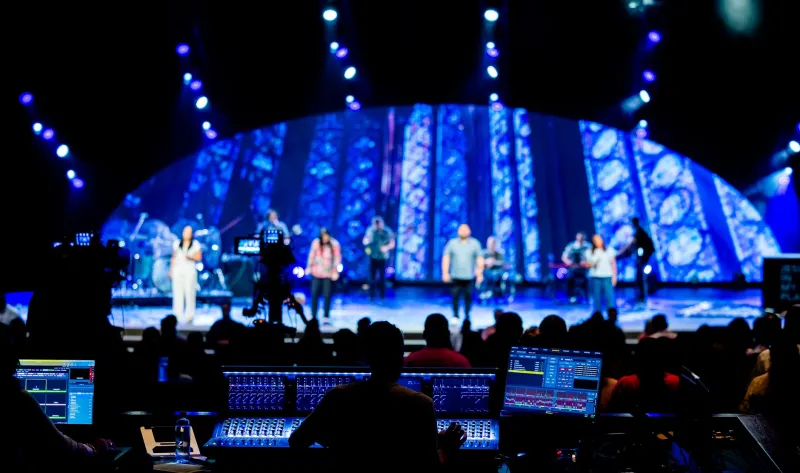
The strategic placement of speakers has become as nuanced as lighting design. Surround configurations in major regional houses such as the Goodman Theatre in Chicago or the American Conservatory Theater in San Francisco allow sound designers to move audio through space with choreographic precision, so that a whispered confidence can seem to originate from just behind the audience's left ear, or a distant memory can arrive as if from somewhere above and behind the action entirely. The result is not spectacle—it is intimacy achieved at scale.
Silence as Instrument
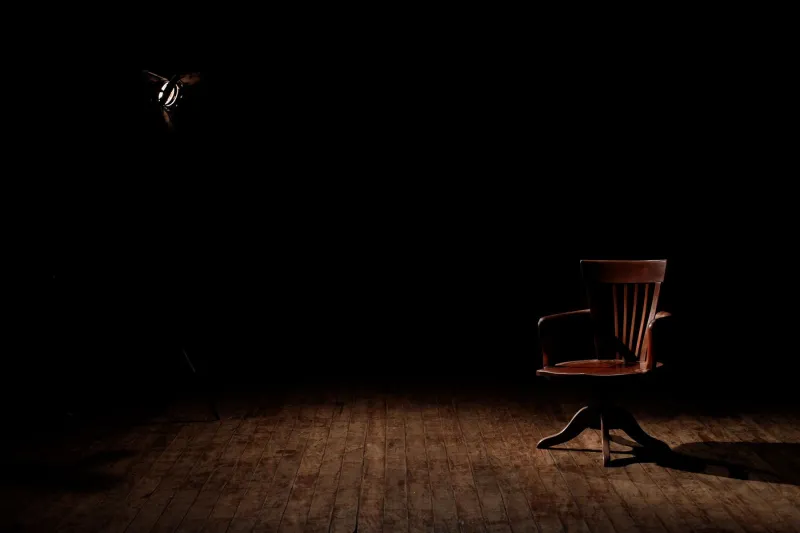
Perhaps the most sophisticated development in contemporary sound design is the intentional, technically demanding use of silence. This is not the passive absence of noise. Achieving true theatrical silence requires the suppression of HVAC systems, the careful management of ambient bleed from adjacent spaces, and the precise calibration of the moment at which all sonic input is withdrawn.
When executed well, a designed silence functions as a kind of negative space—a void that the audience's imagination rushes to fill. Directors and sound designers who work closely together speak of silence as a tool for transferring agency to the audience, compelling them to complete the emotional equation themselves. That participatory quality is, many argue, what separates live theater from every other narrative art form. The silence does not ask the audience to listen. It asks them to feel.
This is not a new idea in theory. Samuel Beckett understood it. Harold Pinter built entire careers on the dramatic weight of the pause. What is new is the technical infrastructure and collaborative intentionality with which American sound designers are now approaching these moments—treating silence not as the absence of their work, but as its fullest expression.
Opening the Sonic Stage
The conversation around sound design has expanded significantly in recent years to encompass a question that the field has historically underserved: what does theater offer to audiences who are deaf or hard of hearing?
The traditional answer has been inadequate. Sign language interpretation and captioning systems are valuable and necessary, but they address the linguistic content of a performance without engaging its sonic dimension. For a deaf or hard-of-hearing audience member, the emotional texture carried by a swelling score or a sudden, room-filling silence has often remained inaccessible.
A growing number of designers and companies are working to change that through tactile audio technology. Specially designed seating equipped with transducers—devices that convert sound into vibration—allows audience members to feel the physical presence of sound through their bodies. Low-frequency elements of a soundscape, the percussive impact of a dramatic musical cue, even the rhythmic pulse of a character's heartbeat can be transmitted as sensation rather than sound. Organizations including the Deaf West Theatre in Los Angeles have been instrumental in demonstrating that sonic experience need not be exclusively auditory.
Visual sonic representation is another frontier. Some productions have begun incorporating real-time visual displays of sound waves, frequency patterns, or abstract visual interpretations of the audio environment, integrated into the scenic design itself. These elements function simultaneously as artistic choices and accessibility tools—an approach that refuses to treat inclusion as an afterthought.
Collaboration at the Heart of the Craft
What has driven much of this evolution is a shift in when and how sound designers enter the production process. Historically, sound was among the last elements addressed in pre-production. Today, the most ambitious work emerges when sound designers are present from the earliest conceptual conversations, contributing to decisions about staging, pacing, and even text.
This collaborative model demands a different kind of designer—one who is as conversant in dramatic theory and emotional psychology as in digital audio workstations and speaker specifications. The training pipelines are beginning to reflect this. Graduate programs at institutions such as Yale School of Drama and Carnegie Mellon's School of Drama have deepened their sound design curricula, emphasizing dramaturgical thinking alongside technical proficiency.
The field is also attracting designers from adjacent disciplines—film, immersive installation art, video game audio—who bring new tools and frameworks to the theatrical context. The cross-pollination is generative, even when it creates productive friction with more traditional approaches.
What the Audience Carries Home
There is something particular about the way sound—and silence—lingers after a performance ends. A striking visual tableau may fade from memory. The precise words of a monologue blur with time. But the feeling of a theatrical moment, the physical and emotional sensation it produced, persists in ways that are difficult to articulate and nearly impossible to dismiss.
Sound designers are increasingly aware of this residue, and they are designing for it. The question guiding the best work in the field today is not simply what does this scene sound like, but what does this scene feel like, and how does that feeling travel home with the audience?
That question—quiet, searching, and profoundly serious—may be the most important one the American stage is asking right now. And the people answering it are doing so, often as not, in the most compelling language available to them: the language of sound, and the eloquent, deliberate silence that surrounds it.