Wired for Wonder: The Technologies Transforming American Theater Without Replacing Its Soul

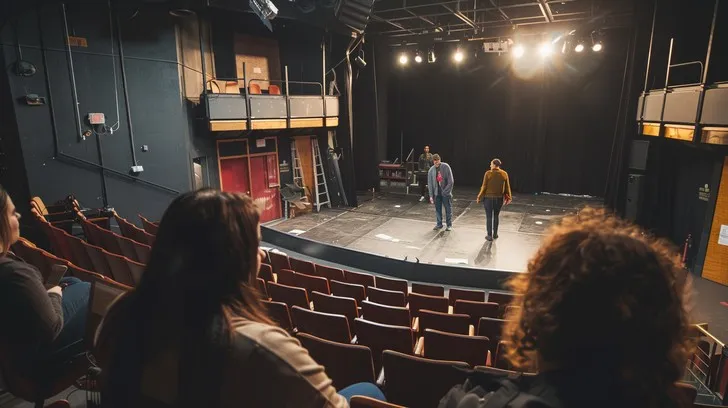
Photo by Photo by Elijah Ekdahl on Unsplash on Unsplash
Stand in the wings of any major American theater during a technically complex production, and you will witness something that would have been unrecognizable to a stage manager from a generation ago. Tablets replace paper prompt books. Wireless headsets carry real-time feeds from multiple camera positions. A projection designer monitors a laptop through which entire architectural surfaces have been transformed into dynamic visual fields, responsive to sound, movement, and live performer input. The machinery of contemporary theater has become extraordinarily sophisticated — and it is reshaping not only how productions are made, but how audiences encounter them.
Yet for all the enthusiasm surrounding theatrical technology, a persistent tension runs beneath the conversation: can innovation genuinely serve the live performing arts without eroding the irreducible human quality that makes theater matter? The answer, as the most compelling practitioners are demonstrating, depends almost entirely on intention.
The Projection Revolution
No single technology has altered the visual grammar of American theater more dramatically in the past decade than projection design. Where painted flats and physical set pieces once defined the limits of scenic possibility, sophisticated projection systems now allow designers to conjure environments of extraordinary complexity and mutability — forests that breathe, cityscapes that dissolve, interiors that fracture and reform in real time.
At the Goodman Theatre in Chicago and the American Repertory Theater in Cambridge, Massachusetts, projection designers have collaborated with directors to create productions in which the visual environment is not a backdrop but a dramatic participant. In these productions, the boundary between the performer's body and the projected image is deliberately blurred — light and shadow become as expressive as gesture or voice.
Mia Kauffman, a projection designer whose work has appeared on stages from Seattle to Washington, D.C., describes the discipline as fundamentally collaborative. "The temptation with projection is to use it to show off," she says. "The discipline is to use it only when it serves the story. When it does, it can do things that no physical set can do. It can make the invisible visible. That is a remarkable gift for a storyteller."
The technology is not without its challenges. Projection systems are expensive to rent, complex to program, and sensitive to environmental variables that live performance routinely introduces — unexpected reflections, the movement of performers across surfaces, the unpredictability of live bodies in a designed space. Many smaller theaters find the investment prohibitive, raising valid questions about whether the projection revolution is widening the resource gap between well-capitalized institutions and their less-endowed counterparts.
Artificial Intelligence in the Design Studio
Beyond the stage itself, artificial intelligence is quietly reshaping the creative process in the production studio. Costume designers at several regional theaters have begun using AI-assisted research tools that can analyze historical textile records, cross-reference period-accurate construction techniques, and generate visual references in seconds — tasks that once required days of archival research.
The implications extend beyond efficiency. For productions with limited design budgets, AI tools can democratize access to historical and cultural knowledge that was previously available only to designers with institutional library access or professional research networks. A costume designer working on a production of a Civil War-era drama at a community theater in rural Georgia can now access the same depth of reference material as a colleague at a major regional house.
Designers are careful to note, however, that AI functions as a research assistant rather than a creative authority. "It can show me what a merchant sailor's coat looked like in 1847," explains one award-winning costume designer who has incorporated AI tools into her practice. "It cannot tell me what that coat should mean for this character, in this production, on this body. That judgment is still mine. It always will be."
Live-Streaming and the Expanded Audience
The COVID-19 pandemic, devastating as it was for the performing arts industry, accelerated the adoption of live-streaming technology in ways that have permanently altered theater's relationship with geography. Organizations that had never considered digital broadcast suddenly found themselves producing high-quality streamed performances out of necessity — and discovered, often to their surprise, that audiences existed for them in places they had never imagined.
The Oregon Shakespeare Festival, long a destination for devoted theatergoers willing to travel to Ashland, found through its streaming experiments that viewers in rural Oregon, in other states, and in countries far beyond the Pacific Northwest were eager to engage with its productions. For individuals with mobility limitations, chronic illness, or caregiving responsibilities that make in-person attendance impossible, streaming is not a consolation prize — it is the only means of access.
The artistic questions raised by streaming remain genuinely unresolved. Theater, almost by definition, depends on the shared physical presence of performers and audience. The energy that passes between a live actor and a live crowd is not reproducible through a screen. Yet the argument that streaming diminishes theater ignores the lived reality of millions of Americans for whom the alternative to streaming is not in-person attendance — it is no theater at all.
"We are not trying to replace the live experience," says the digital engagement director at a major Midwest theater company that now maintains a robust streaming library. "We are trying to extend an invitation to people who have never received one. If they watch a stream and fall in love with the work, perhaps someday they find their way into a seat. Or perhaps they never do, and they still have theater in their lives. Either outcome is worth celebrating."
Interactive Programs and the Digital Playbill
Among the less dramatic but practically significant technological shifts in contemporary theater is the evolution of the program — that venerable paper document that audiences have carried into performances for more than a century. Digital programs, accessible via QR code, are now standard at many American theaters, offering not only the traditional content of cast biographies and production notes but video interviews with designers, interactive dramaturgical essays, and post-show discussion guides.
For performers and educators, the digital program represents an opportunity to extend the theatrical experience beyond the walls of the venue. A student attending a production with their class can access curriculum-aligned materials before the performance. An adult subscriber can deepen their engagement with the text through audio commentary from the director. The program, once discarded in the lobby, becomes a lasting point of connection between the audience and the work.
Honoring the Irreplaceable
For all the genuine excitement surrounding theatrical technology, the most thoughtful voices in the conversation return, consistently, to a simple conviction: that no innovation, however sophisticated, can replicate the fundamental transaction of live performance. An actor standing in real space, breathing real air, responding in real time to the energy of a real audience — that encounter is not a problem to be solved by technology. It is the reason theater exists.
The wisest application of new tools, then, is not to simulate or substitute for that encounter, but to clear the path toward it. Technology that makes production more efficient, that extends access to underserved audiences, that helps designers realize visions that would otherwise remain unrealized — that technology serves theater. Technology that draws attention to itself at the expense of the human story being told does not.
The stage, in the end, is a place where people gather to witness what it means to be alive. Every tool that helps more people gather there — and that honors the gravity of what they find when they do — is a tool worth having.