Stages Without Borders: How Independent Theater Collectives Are Rewriting the Rules of American Performance
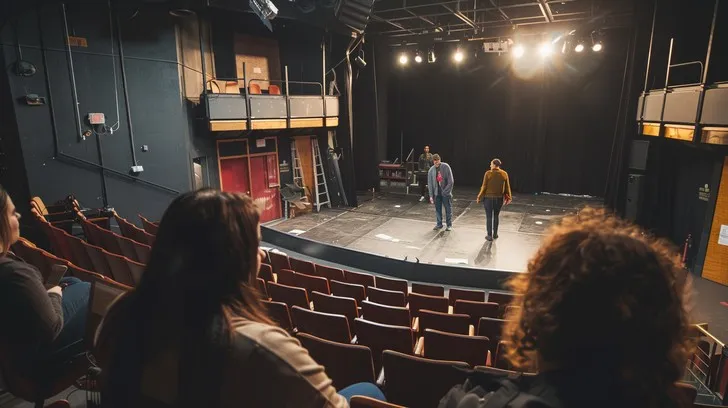
Photo: small independent theater company rehearsal intimate performance space, via images.stockcake.com
The rehearsal space is a rented church basement in East Nashville. The lighting rig consists of borrowed LED panels and two theatrical fixtures purchased secondhand from a college drama department closing its doors. The cast of seven has been rehearsing for eleven weeks without pay, sustained by a shared commitment to a new play that no established institution was willing to produce. Opening night is three weeks away, and tickets — priced on a sliding scale to ensure accessibility — are nearly sold out.
This is not an exceptional story. Variations of it are playing out in cities and towns across the United States, wherever artists with more ambition than capital have decided that the absence of institutional support is not a reason to wait.
The New Landscape of American Independent Theater
The American theater ecosystem has long been defined by a recognizable hierarchy: Broadway at its apex, followed by the League of Resident Theatres (LORT) regional companies, then smaller nonprofit theaters, and finally the vast, largely invisible terrain of independent and emerging companies operating at the margins of institutional recognition.
In recent years, however, that hierarchy has begun to feel less stable — and less relevant. A confluence of factors, including the disruption of the pandemic era, rising production costs in major markets, and a growing appetite among audiences for stories that fall outside mainstream theatrical canons, has created conditions in which independent theater companies are not merely surviving but actively thriving on their own terms.
These collectives operate under a variety of organizational models. Some are formally incorporated as nonprofits; others function as artist cooperatives, sharing revenue and decision-making equally among their members. Still others exist in a more fluid state, assembling and reassembling around specific projects without fixed institutional infrastructure. What unites them is a disposition toward creative problem-solving and a refusal to accept scarcity as a barrier to meaningful artistic work.
Constraint as Creative Catalyst
Among theater artists who have spent time in both well-resourced institutional settings and independent companies, a recurring observation emerges: limitation, properly embraced, can be generative.
When a production cannot afford an elaborate scenic design, the director is compelled to find theatrical solutions — the strategic use of light and shadow, the choreography of bodies in space, the power of an object to carry symbolic weight. When a company cannot afford to hire a composer, it discovers that a cappella vocal arrangements or the deliberate absence of underscoring can create a more intimate and affecting soundscape than a full orchestra.
This aesthetic of necessity has produced some of the most formally adventurous theater in recent American history. Independent companies in cities like Philadelphia, Houston, Minneapolis, and Los Angeles have developed distinctive visual and narrative vocabularies precisely because they could not afford to default to conventional theatrical production values. The constraint became the aesthetic.
For performers, working within these environments frequently provides an education that no conservatory program can fully replicate. When there is no stage manager to handle every logistical detail, when every company member is expected to contribute to building, marketing, and administration alongside their artistic work, the result is a kind of theatrical literacy that encompasses the full ecology of production. Actors who come through independent companies often describe a fundamentally different relationship to the work — one characterized by ownership, investment, and a granular understanding of how theater is actually made.
Funding the Unfunded: Creative Approaches to Financial Survival
The financial realities of independent theater are neither comfortable nor glamorous. Most companies in this sector operate on annual budgets that would not cover a single week of a mid-sized Broadway production. Grants from national foundations such as the National Endowment for the Arts, the Doris Duke Charitable Foundation, and various state arts councils provide critical support, but competition for these funds is fierce and award amounts are frequently modest relative to operational needs.
In response, independent companies have developed a range of supplementary funding strategies that reflect the same ingenuity they bring to their artistic work. Crowdfunding campaigns — conducted through platforms such as Kickstarter and Seed&Spark — have become a standard tool, with the added benefit of building direct relationships between companies and their audiences. Pay-what-you-can pricing models, once considered financially untenable, have proven effective at expanding audience bases while generating sufficient revenue to sustain operations.
Some companies have pursued more unconventional arrangements: co-productions with community organizations, residencies in non-traditional spaces whose owners provide venue access in exchange for programming, and revenue-sharing agreements with local restaurants and bars that benefit from the foot traffic generated by performances. These arrangements require a level of entrepreneurial creativity that traditional theatrical training rarely addresses — and yet, increasingly, they represent the practical reality of sustaining independent artistic work in America.
Amplifying Underrepresented Voices
Perhaps the most significant contribution of the independent theater movement is its role in expanding the range of stories told on American stages. The economics of mainstream theatrical production have historically favored material with broad commercial appeal — a calculus that has, by design or default, marginalized stories from communities whose experiences fall outside the perceived mainstream.
Independent companies, freed from the obligation to serve large subscriber bases or satisfy institutional donors with conservative programming preferences, have demonstrated a consistent willingness to take risks on new work by writers from underrepresented backgrounds. Over the past decade, many of the most critically significant new American plays have had their first productions not at established regional theaters or on Broadway, but at small independent companies willing to champion work that the mainstream marketplace had overlooked.
This is a pattern with historical precedent. Many of the playwrights now considered central to the American theatrical canon — from Lorraine Hansberry to August Wilson — found their early audiences in spaces that operated outside the theatrical establishment of their time. The independent theater movement of today is, in this sense, continuing a tradition of artistic risk-taking that has consistently enriched the broader culture.
What the Mainstream Can Learn
The relationship between independent theater and established institutions need not be adversarial. At its best, the independent sector functions as a laboratory — a space where formal and narrative experiments can be conducted without the weight of institutional expectation, and where successful innovations can eventually migrate into the broader theatrical ecosystem.
For organizations committed to the vitality and inclusivity of American theater, supporting independent companies is not merely an act of charity toward struggling artists. It is an investment in the long-term health of the art form itself. The stories being told in those church basements and converted warehouses, by those seven actors rehearsing without pay, are the stories that will define what American theater becomes.
At EA Theatre, we believe that the stage comes to life wherever there are artists willing to inhabit it fully — regardless of the size of the budget, the prestige of the venue, or the institutional imprimatur behind the production. In the work of America's independent theater collectives, that belief finds its most vivid and vital confirmation.